The Do’s and Don’ts of Celebrating Pride in 2026
In 2026, Pride is as much a statement as it is a celebration. With changing geopolitical attitudes towards Pride, attacks by the American President on D.E.I., and a rise in alt-right conservative values, Pride is under pressure from more angles than ever before. That makes how we celebrate Pride more important than ever, too.
Showing up for the queer community can't stop at a rainbow flag emoji or a single Instagram post. Pride celebrations and acknowledgements should be authentic, genuinely supportive, and action-forward. Performative gestures that generate good optics without creating real change don't cut it anymore.
Here's a quick cheat sheet to help you make sure your Pride celebrations are actually worth celebrating.
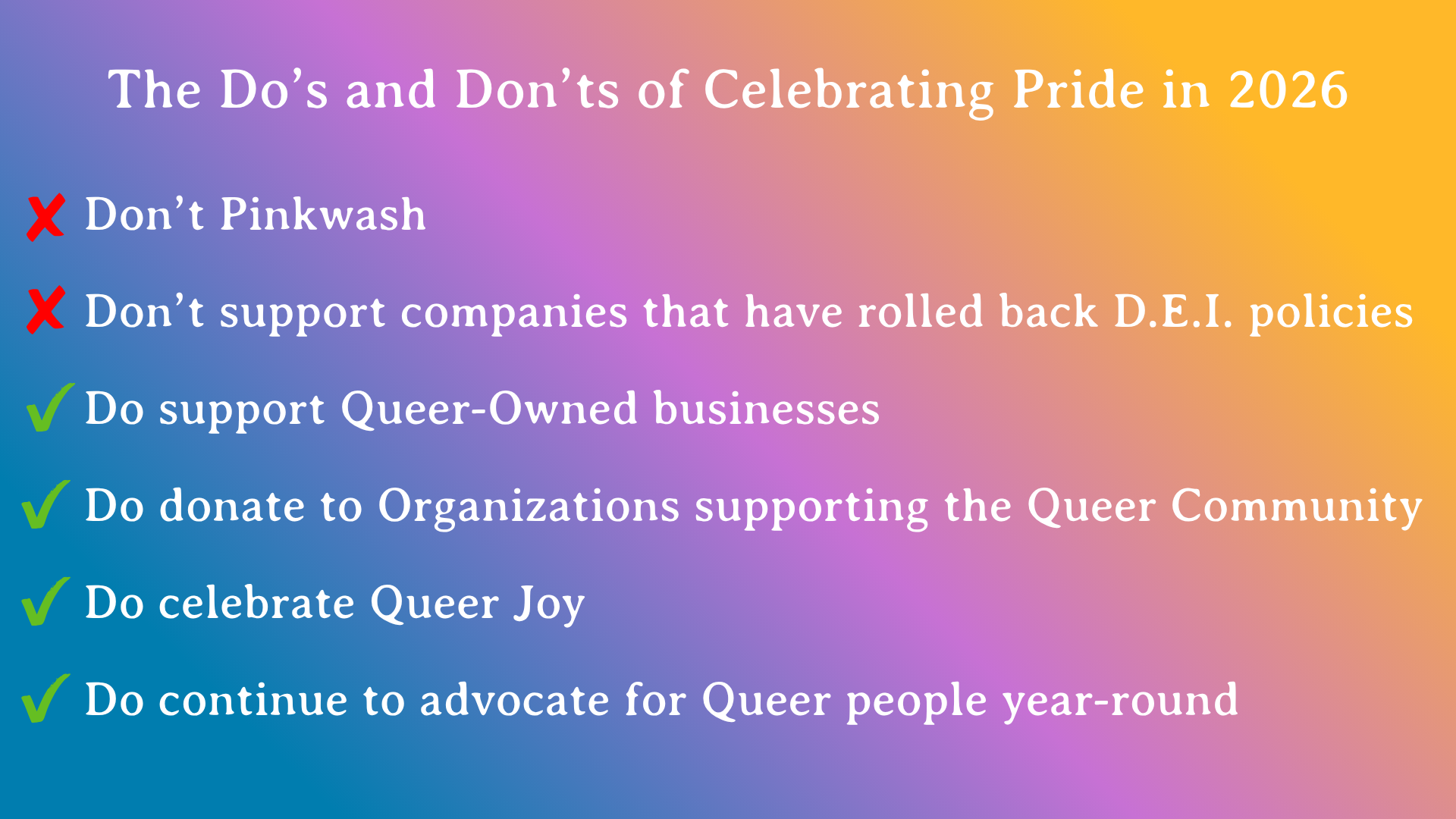
Don’t Pinkwash
The practice of pinkwashing (or rainbow-washing) means using 2SLGBTQIA+ symbols or messaging for public relations or profit without providing real support to the queer community. Think of it as paying lip service to Pride without backing it up.
You've seen it before: a company swaps its logo for a rainbow version every June, or sends a float to the local Pride parade, then goes radio silent the other eleven months of the year. These gestures aren't inherently bad, but they need to reflect the organization's actual values (and last longer than one month).
If you’re slapping a rainbow logo on your social media pages, you best be backing it up with actual policy changes, charitable giving, advocacy, and creating real space for 2SLGBTQIA+ employees and customers.
Otherwise, it’s performative — and people notice.
Don’t support companies that have rolled back D.E.I. policies
It’s been a tough few years for Diversity, Equity, and Inclusion.
In 2025, Trump issued a sweeping directive to attempt to ban D.E.I. programs at the federal government and its contractors. It placed D.E.I. workers on paid leave, shut down agency diversity offices, and revoked decades-old executive orders that previously required affirmative action.
Since then, a startling number of businesses worldwide have followed suit and dismantled D.E.I. programs that protect queer people and other marginalized groups. It’s a bad look, and these companies don’t deserve your business or your loyalty.
On the other hand, many companies are fighting back and doubling down on their DEI efforts, like Lush, Delta, and Costco. Vote with your wallet and support the organizations fighting for a more inclusive world.

Do support Queer-Owned businesses
Speaking of voting with your wallet, Pride Month is the perfect time to be extra intentional about supporting queer-owned businesses. Supporting a local queer-owned business with a purchase sends your dollars straight back into the community and is one of the most direct and impactful things you can do.
If your budget is tight, there are other ways to support queer-owned businesses. Try attending one of their events, sharing their social media or website with others, volunteering with them, or letting them know how much they mean to the community.
Luckily, for us in Manitoba, there are many incredible queer-owned businesses to support. Check out the Rainbow Pages for a comprehensive list of local businesses, or the Canadian Queer Chamber of Commerce’s list of Rainbow Registered businesses nationwide.
Save ‘em, share ‘em, and use ‘em year-round.
Do donate to Organizations supporting the Queer Community
There are incredible organizations doing vital, life-changing work for queer people every single day, and many of them are underfunded and under-resourced, especially right now.
Locally, we love the work that Sunshine House Winnipeg and the Rainbow Resource Centre do in supporting 2SLGBTQIA+ adults and youth. The Rainbow Resource Centre has a nice roundup of other Manitoba 2SLGBTQIA+ organizations here. Or, look into national and international organizations that advocate for queer rights, provide crisis support, fund legal battles, and amplify queer voices.
If you're able to donate or volunteer your time, your support makes a real difference.
Do celebrate Queer Joy
Whether you’re a queer person or an ally, a big part of Pride Month is celebrating queer joy. With so much hate and oppression in the world today, joy is more important than ever. Try attending Pride events, consuming queer media, celebrating Pride with loved ones, or finding special ways to celebrate the queer people in your life. Let them know you see them, you're proud of them, and you're glad they exist.
As poet Toi Derricotte wrote, “Joy is an act of resistance.”
In times like these, choosing to celebrate loudly, proudly, and with full hearts is a radical and necessary act.
Do continue to advocate for Queer people year-round
Here's the thing about Pride — it's one month, but the work doesn't stop on July 1st.
The policies that threaten queer people don't take a break, and the organizations supporting them need funding all year. The queer people in your life need your allyship in February just as much as they need it in June!
Commit to carrying your Pride Month energy forward. Follow queer-led organizations, stay informed on 2SLGBTQIA+ legislation, vote for politicians who protect queer rights, and speak up when you witness discrimination. Keep showing up and helping to make the world a safer, more tolerant place.
Our Guide To Social Search Optimization (SSO) In 2026
- by Luke Thiessen
The landscape of online search is fracturing, and while AI chatbots get most of the credit for stealing traffic away from traditional engines, I believe us marketers should be paying more attention to social search.
Some experts report that Google is now handling just 27% of all online searches, while the rest are happening on social media and AI platforms. Broadly speaking, AI chatbots are eating up more of the remainder, but there is also a significant generational divide.
According to surveys by Sprout Social, Gen Z prefers social media for online search over AI or traditional search engines, with 41% choosing social search. And those numbers grow even higher when you look at Gen Z users searching specifically for brands and product discovery.
So, if young consumers are skipping Google and increasingly looking for brands and products on social media, how do you make sure they find you? Let’s look at the basics of social search optimization (or SSO) and how to best harness that for your brand in 2026.
Keyword and phrase research
On TikTok and Instagram, you can glean a lot of information by trying out the search bar yourself.
Try typing in a few key words relating to your brand, like the product or service category, your city or location, or anything that relates strongly to your business. Then watch and see what the platform suggests to auto-complete your search. These will be some of the most common search terms people are already using on the platform, making them a good place to start.
Another angle on this is to find popular and viral videos within your niche – like video reviews of similar products, unboxing or how-to videos – and look at the suggested search links underneath. These are search terms the platform is suggesting based on categories it’s already assigned to that video or content, which can be useful in understanding how the algorithm labels or “thinks about” your products or niche industry.
Optimizing your content
Social media algorithms have gotten pretty advanced, especially when it comes to video. It’s not just about your caption anymore (although that is still important!). Now, boosted by AI, these algorithms are listening to your audio and reading text within your video and images to determine what your content is about.
Optimizing your content for the algorithms now means using your keywords and key phrases in all of these places, and doing so in a way that the AI can understand. Make sure your keywords are clearly spoken aloud in the first few seconds of your videos, and put them in easy-to-read text in that beginning section as well. Same goes for your captions, which should include your keywords and phrases as close to the beginning as possible.
Optimizing your bio
When it comes to Social Search Optimization, the algorithms are also looking at your bio for clues about your content and authority.
This means putting relevant keywords in your bio to improve the searchability of both your profile and your content. Aim for a few major keywords along with whatever else you want to say here.
You should also be putting keywords in your username. You’ve probably seen examples of this in certain industries where they figured this out early – personal trainers and fitness influencers, freelance marketers, business and finance consultants – where a username will include both an actual name and a short description of what they do.
This can be tricky, depending on your business and name, but try to include a couple of keywords or one short phrase; something that will capture what most people searching for your type of business might include in a query. For example: “Revolver Coffee | Gastown, Vancouver” or “John Smith | Winnipeg Commercial Real Estate”.
Optimizing your engagement
This is the trickiest part, because you can’t control the behaviour of your followers or other users on social media, but creating content that drives certain types of engagement can also help your SSO.
All engagement is good engagement, and will help the overall searchability of your content. However, the best types of engagement are saves, shares and comments. Try to create and format your content in such a way that it encourages one or more of these behaviours. Having useful information in your content can lead to more post saves and shares, while asking questions or specifically requesting some kind of feedback can lead to more comments – and with comments, the longer and more specific the better.
We can help
Social media strategy and content creation are our bread and butter. It can be daunting and time-consuming to do this work on your own.
At Starling Social, we help brands and nonprofits of all sizes develop social media strategies and run accounts day-to-day using a combination of solid best practices and sharp creativity. We also offer one-time audits which can help get you moving in the right direction with minimal commitment.
Get in touch today to book a free discovery call – we would love to help you navigate this world and get more out of your social media and digital marketing.
Raw & Unpolished: When to Go Low-Fi With Your Social Media
Forget everything you thought you knew about creating content for social media...
Just kidding! This idea isn’t new, and isn’t meant to make you stop putting in effort into your social media content. But increasingly, we are seeing situations and cases where more raw and unpolished content can be very effective for brands wanting to get attention.
Broader trends across social media, including the shift toward more video and amateur-creator-driven content, have ushered in an age of low-fi, longer-form video content. These types of posts get some of the best engagement across most platforms, and for the right pieces of content, can significantly boost views and reach.
Let’s look at some potential cases where your company should (or shouldn’t) break from your usual standards and consider a simpler, unpolished type of post or digital ad.
When it works
Assuming your company has strong brand standards, a robust social media strategy, and is generally following best practices, it can be daunting and hard to know when to break the rules.
One of the best and most natural entry points to low-fi brand posts is when responding to something negative, critical, or even just timely. If you have received a negative-but-unwarranted comment on a previous post, or a bad review that isn’t legitimate, it can be a chance to grab attention by posting a screenshot and then having your CEO (or other spokesperson) respond with humour and helpful education.
In this case, the context – responding to something negative, incorrect and timely – makes the unpolished nature of the post make sense. Your followers will understand that this is a break from your regularly scheduled programming, and the post becomes all the more interesting for it, without detracting from your overall brand and professionalism.
Now, what I’ve been describing is a response to comments, reviews or other criticism which is off-base and warrants a correction or a joke, but this format also works for legitimate apologies. If your brand finds itself having to admit to a mistake, address real concerns, or something else challenging, a raw and straightforward video of your spokesperson talking to the camera is often the best way to go.
Another use case for a less-polished post is when jumping on trends. Being quick and timely is a huge part of a successful trend-chasing post, and your followers will again understand the raw nature of a post that clearly had to be made quickly in order to capture the moment. The recent set of fast food burger-tasting videos, starting with the CEO of McDonalds, is an example of this; brands that got on it quickly did well, and those who waited too long and made anything too polished did not.
Why it works
In addition to (generally) being more timely, these raw and unpolished posts are an opportunity to humanize your brand, showing the real people behind the company. The content also looks more like what a user is seeing from their friends and favourite influencers rather than from other brands, which helps draw people in from the start.
To capitalize on these natural benefits, it’s best to involve senior leadership (like your CEO) and show real people from your company wherever possible. And when it’s not possible or doesn’t make sense, consider using a format that feels casual and familiar to your followers, like a screenshot from a notes app with no fancy design elements added.
Rules of engagement
While there are no established rules in this space, experts suggest keeping these types of posts below 20% of your total social media content. Even if they become your best-performing post format, resist the temptation to go back to that well too often.
For ads, it’s a different story. Raw and unpolished content – video or otherwise – can make for effective digital ads using some of the same principles as feed posts, and don’t necessarily have to be balanced by other types of ads. However, you still want to avoid ad fatigue, so if you are running a campaign using this style of content, consider making a few versions or altering the creative in some way every week or two.
In all cases, something to remember is that “raw” doesn’t mean low-quality. You still want your followers and viewers to be able to understand your message and take whatever action you are hoping for. Good-quality audio for any voices, working links and good copy are all still important.
As with many things, it’s important to know the rules and why they exist before trying to break them. Best practices exist for a reason, and you can think outside the box without leaving them behind entirely.
We can help
Social media strategy and content creation are our bread and butter. It can be daunting to do this work on your own, and time-consuming to create new types of content.
At Starling Social, we help brands and nonprofits of all sizes develop social media strategies and run accounts day-to-day using a combination of solid best practices and sharp creativity. Get in touch today to book a free discovery call – we would love to help you navigate this world and get more out of your social media and digital marketing.
Formats For Success: Best Post Types for Each Social Media Platform
- by Luke Thiessen
Organic social media just keeps getting tougher for brands and marketers, and with the algorithms constantly changing, new formats being introduced and prioritized, and user engagement habits shifting, it can be hard to punch through.
A great post in any format should still reach an audience, but catering at least some of your content to the algorithms and engagement styles unique to each app can do a lot to maximize your reach. So, we’re going to look at the best formats for reach and engagement across most of the major social media platforms, what they work best for, and how to harness this information for your social media marketing.
Best post types for Instagram
Posts that work best for Instagram can really depend on your goals, but one thing that is consistently and broadly true is that static single-image posts – yes, the kind the platform was built on – generally perform the worst.
Carousels tend to be the best format for overall engagement on Instagram. These are posts with multiple images or videos which users can swipe through. When you swipe on these posts, Instagram reads this as you spending more time and interacting with the post, even if you don’t press like or engage in any other way.
Some of the success of the format also comes from the types of content that many brands use it for, like “best-of” roundups, how-to guides, before and after photos, and other useful or extra-engaging content. The extra time people spend with these posts, including saving them or sending them to other users, also leads to higher average engagement rates.
Reels, on the other hand, are often best for reaching new audiences on Instagram. They are more likely than any other post type to end up in front of users who don’t follow you but have shown interest in similar content, and are overall the format users spend the most time with on the platform.
Stories generally come in third place, but are not to be ignored. Many users spend more time in stories than scrolling their feed, and it’s important for reaching and engaging your existing followers to be there often.
Best post types for Facebook
You might think of Facebook as being only good for arguments in the comment section, and that’s because – surprise! – that’s what the algorithm feeds on.
The best type of post for overall engagement on Facebook is something that draws a lot of comments. Even a purely text-based post (like the big text on colourful backgrounds you see so often) asking a yes or no / either-or question can be a ticket to higher engagement and reach within your followers.
For reaching new people, Facebook is similar to Instagram in that reels (vertical, please) are the number-one way to gain new followers and views from outside your existing audience.
Thirdly, live videos can be a highly effective way to reach your existing followers, as Facebook will even go so far as to send push notifications to some of your followers letting them know you are live. Timely and event-based content like product launches, as well as intentional engagement like Q&A sessions, can be great use cases here.
Beyond these formats, Facebook can really be trial-and-error. It’s a strange place where long-form text rants can go viral while high-quality videos full of relevant and interesting content can pass unseen into the void.
Best post types for TikTok
If you haven’t spent much time on TikTok as a user lately, you’d be forgiven for thinking it’s just a short-form video app. Perhaps surprisingly, some of the best-performing posts on the platform are now photo carousels and longer-form video.
Similarly to Instagram, a good photo carousel that people spend time with can be highly effective, as TikTok’s algorithm counts the swiping and lingering time as a high degree of engagement. In terms of content, similar things work well here as with Instagram, and for the same reasons – saves and sends count for a lot.
And while you certainly won’t be punished for posting the common short-form video formats that TikTok is most known for, sometimes a longer-form video can be a good way to get in front of new audiences, as they are increasingly popular in search. A highly informational video with a caption and opening line that answers a commonly searched question can be the TikTok equivalent of great SEO.
Best post types for LinkedIn
Not everyone counts LinkedIn as a social media platform, but when we’re talking about business and nonprofit marketing, it’s just as important as the others – if not more so.
LinkedIn is a lot like Facebook in that there are many different possible post formats, and any of them can do well if the post is catered to your audience and well-crafted. However, some formats are more likely to help you accomplish certain goals.
Carousel posts – in LinkedIn’s case, uploaded as multi-page PDF documents – are often some of the best posts for reach on the platform. Provided the content is useful and engaging, users will spend time with it, save it, and in turn show the algorithm it’s worth showing to more people.
Newer to the platform but gaining importance are short-form video posts. These should be vertical, like TikTok videos or Reels, and don’t need to be anything fancy; under a minute and shot on your phone is just fine. However, remember to use subtitles – most videos are played without sound.
Best post types for Threads, X, Bluesky, etc.
The most popular text-first platforms may have fewer options than Instagram and Facebook, but there are still some approaches that work better than others.
On Threads, images do often perform well, especially things like memes and screenshots of things like notes and lists, where relevant to your brand – but you certainly don’t need images, and may be better off without them. The thing most likely to boost your reach and engagement on Threads is generating discussion; questions, polls, hot takes, and other conversation starters get people engaging with and re-posting your content.
The same advice generally goes for the other text-first platforms, although X (formerly Twitter) can be an outlier in the way it embraces video. We don’t spend much time or energy on X these days, but data shows that short video clips (under 15 seconds) in vertical format are a popular candidate for viral posts on the platform.
Strategy is key
It might be tempting to take all of this and go all-in on one or two formats across all platforms, but ultimately, different formats will serve different goals. A sustainable social media content plan should involve multiple different formats, catered to the individual platforms you’re on. And we know the algorithms and options will change again in the future, so it’s important not to pin your entire aesthetic on one type of post, knowing that might not work or be available forever.
At Starling Social, we help brands and nonprofits of all sizes develop social media strategies that work. Get in touch today to book a free discovery call – we would love to help you turn your social channels into something that builds relationships with your audience and drives revenue for your organization.
Our Guide to Email Marketing in 2026
- by Luke Thiessen
Email marketing may be one of the oldest forms of digital marketing, but in a landscape where you’re increasingly having to pay for reach on supposedly “free” platforms, a direct line to your customers probably sounds pretty good.
While it’s far from new and sexy, email marketing is still pulling in industry-high ROI rates, with many studies showing an average return of $36 to $40 for every $1 spent. And for businesses embracing the latest tools for targeting, segmentation and personalization, that ROI can be even higher.
It’s true that privacy laws and spam detection filters have made some aspects of email marketing more difficult – even for those of us doing everything right – but given the low cost and high potential return, it’s well worth the effort.
Let’s look at some trends and new technology we’re following for email marketing in 2026, along with how to ensure your emails are getting delivered, getting opened, and avoiding unsubscribes.
Email marketing trends for 2026
One of the biggest shifts in email marketing in recent years has been toward hyper-personalization.
This is where technology has really supercharged things, from AI-powered CRM software to analytics and segmentation tools within your email marketing platform. For any business with an online store, gone are the days of a mass email to all subscribers with nothing but the first name swapped out.
Now, if you can capture someone’s email (and permission – we’ll get to that shortly) when they start shopping, your CRM and email tools can send a series of automated emails tailored to that individual, and to what they viewed and did on your site.
Another trend we’re seeing lately is interactive elements in marketing emails, especially less sales-focused ones. Often this is some kind of poll embedded into the lower part of a more informational email, asking the reader to rate how they liked the email or what they liked best (or disliked) about it. This provides valuable feedback for your email marketing program, but also makes your email more interactive for the reader, feeling more like a dialogue and less like advertising.
Privacy, spam filters and CASL
Government and email clients alike have done a lot in recent years to help protect consumers’ privacy, and protect them from spam and scam emails. In some ways, this makes our job as marketers harder, but in other ways, it has also helped keep email marketing viable by protecting people’s inboxes.
What this means for us is that in order to build a successful email program, we need to follow the rules – both legally and in terms of best practices.
Canadian Anti-Spam Legislation (or CASL) is the biggest piece of this for marketers in Canada. Most email marketing platforms have compliance built-in for Canadian users, but to summarize: CASL requires explicit opt-in, meaning the customer must proactively sign up. No pre-checked “subscribe” boxes or implied opt-in buried in fine print.
Beyond following the law, you also want to ensure your emails are making it through spam filters. This starts with ensuring your sending email address is verified and set up correctly with your marketing platform, which is more of a technical and infrastructure challenge than a marketing one.
Another aspect to avoiding spam filters is simply respecting your email recipients and not sending them something they are likely to mark as spam. Consider the volume and frequency of your emails, the balance of content (we’ll talk more about that shortly), and the overall tone.
Building your email list
Adding new subscribers to your email list is a harder and slower process than it used to be. Gone are the days of buying email lists or simply adding anyone whose email address you’ve collected to your list automatically.
But the same things that have made it harder to build the lists have also made the email addresses you do collect properly even more valuable.
The most common way to do build an email list in 2026 is to prompt sign-ups on your website, usually with a pop-up form, and to offer something in return.
Whether it’s a discount code, a PDF of some original research or other useful content, entry into a prize giveaway, etc – a compelling offer is often the best way to get someone’s email address and explicit opt-in. Ensure whatever the offer is can be delivered by email.
The downside here is that many of these offers are one-time discounts or a single piece of downloadable content. If your ongoing email marketing is interesting and relevant to the reader, they may stick around, but many will unsubscribe shortly after receiving the offer.
One way to combat this churn and keep people subscribed is to make it clear up front is to offer ongoing benefits to your subscribers, and make that clear up front. When someone signs up for email marketing based on an initial offer, make sure to tell them that email subscribers get exclusive discounts throughout the year, or are entered into a draw every month, or something similar. The easiest action a person can take is no action at all, so if they have an incentive to stay subscribed, they will.
The 60/40 content rule
A general rule of thumb with email marketing content is the 60/40 rule. This means you want 60% of your emails to have no selling involved.
What do I email my customers if I’m not selling to them? I’m glad you asked.
Nonprofits are often better at this, because they can share stories of impact, of how your donations are helping their cause. But for-profit businesses have plenty to talk about. You just have to get more creative.
Do you sell food products? Share recipes. Clothing? Share outfit inspiration. Service-based business? Share tips on when, why, or how often people should be using your service, and how to maximize its impact or usefulness.
This is also a good place to get interactive with your customers, offer giveaways, and otherwise get them engaging with you. Ask them to send in photos of themselves using your products in order to win a prize. Ask them to share their recipes for inclusion in a future recipe. Get creative with it.
That 60% of your email marketing is truly the most important long-term. The remaining 40% where you sell your products or services, or ask for donations, etc, is only useful if your subscribers are sticking around and opening your emails.
We can help
Need help getting started on your email marketing program? Struggling to attract new subscribers, or keep people subscribed long-term? Get in touch today to book a free discovery call – we work with all kinds of businesses and nonprofits on their digital marketing strategy and would love to help make your email program work better for you.
Do Social Media Trends Really Help My Marketing?
We love a good social media trend.
What could be better than noticing a new trend or format in its early stages – especially one that fits perfectly with your brand – and jumping on it quickly, then seeing it take off and boost everything from your follower count to views and engagement?
That’s the high most of us marketers are chasing a lot of the time. We know we can’t hit that with every post, but it sure feels good when it works, and the numbers make us look even better. But is it worth it?
I won’t leave you hanging here; the short answer is yes – but with some significant caveats.
Let’s look at some data, explore how and when to chase that trend for best results, and maybe even when to let the trend pass you by.
How to capture the moment
There are two main things to consider when deciding whether to jump on a social media trend: timing and fit.
Timing is crucial on several fronts. Most social media trends have a pretty short shelf life, and many users – especially your younger audience – respond negatively to brands posting old or “stale” trends. By the time you’ve noticed the trend, chances are good it’s already past the halfway point to becoming stale. Even if you have caught something fairly early, you’ve really only got a few days at most before your take on it feels too late or irrelevant.
There are some exceptions to this, especially with more niche and industry-specific trends, which tend to move more slowly and have a longer shelf life. And if your audience or follower base leans a little older, this can shift your window and give you a little more time as well.
Another reason timing matters is that you may have other time-sensitive content in the works or in your content schedule, so dropping everything to chase a trend might be a trade-off with more risk than reward. So, consider what it will take to make your trend-chasing post, as well as what you might be sacrificing to make that happen.
If you have caught a trend early enough and the timing feels good, the other thing to consider is fit: does this particular trend feel appropriate for your brand and your audience?
It’s important to remember that while a given social media trend might be popular with certain groups and online communities – maybe even ones you belong to personally – that doesn’t mean it will be familiar or relevant to your brand’s followers. You should also consider your brand’s online personality and image, and whether a given trend would damage or take away from that in any meaningful way.
The potential benefits
The main argument in favour of chasing social media trends is that the algorithms – especially on platforms like Instagram and TikTok – prioritize content that uses trending audio, hashtags and formats. They also value certain types of engagement more highly than others, especially shares – meaning if a user finds a post funny or relatable and sends it to a friend, they will reward you for it in the algorithm.
If you manage to make something that captures a trend well, at the right time and in the right way, you also have a much better chance of making it onto people’s “for you” and “discover” pages, and ultimately going viral. More than two-thirds of videos on TikTok are viewed from the “for you” feed (versus “following”), so breaking outside of your follower base is a huge benefit of going even slightly viral, and can often grow your follower count noticeably in a very short period.
The challenges and pitfalls
For all the benefits of posting a video or reel that goes viral, there is evidence that it’s getting harder to do, and that the results can sometimes be counterproductive.
After rapid growth in 2024, Instagram Reels saw a decline in overall reach and impressions last year (down by more than a third in 2025). A report last year from Sprout Social also found that one-third of consumers feel that brands jumping on social media trends is “embarassing,” and another quarter feel it’s only effective within 24 to 48 hours of a trend’s beginning.
Perhaps most significantly, research shows the longer-term effects of going viral on social media are neutral or even net-negative for many brands. Engagement tends to drop sharply within days of a viral post, often dipping below what it was beforehand, and despite an increased follower count, a viral post doesn’t seem to improve engagement for a brand at all. The researchers in this particular study suggest that, according to the data, consistent high-quality content over the long term is more likely to lead to stable growth and engagement.
My post went viral, now what?
When you have a post go viral, there are some things you can do to take better advantage of the moment and to mitigate some of the inevitable post-viral slump.
Posting again shortly after the peak of a viral post is helpful, as well as prioritizing high-engagement types of content for a time. On Instagram, carousels have become one of the best post formats for engagement and algorithmic performance, so consider making your next post a carousel.
Another thing to do is adjust your expectations. Going viral is unpredictable, and despite your past success and best efforts, you may not do it again, or at least not right away. Many brands who gain followers with a viral post will also lose up to one-third of those new followers within a month. Recognize the data around your viral post to be an outlier, and continue working toward sustainable growth.
We can help
If you haven’t heard by now, social media content and data are kind of our thing, and we’d love to help your brand maximize its online presence. If you need someone to help your brand build a strong and engaged following online, and maybe even make some viral content along the way, get in touch for a free discovery call today!
Why IWD 2026 Matters More Than Ever
It’s almost time for International Women’s Day, a global moment to celebrate the achievements of women while recognizing the work that still lies ahead in the pursuit of true equity. On Sunday, March 8, communities around the world will highlight the progress made and shine a light on the challenges women continue to face.
As a women-founded business, Women’s Day holds a special place in the hearts of the Starling Social team. Each year, we use this moment to reflect, to educate, and to share tangible ways you can show up to make a difference.
Why IWD 2026 matters more now than ever
.png)
The numbers show we’re not there yet
Despite decades of progress, gender inequality remains deeply entrenched in everyday life and in systems of power. According to figures from the UN, women hold just 30 per cent of managerial roles and continue to shoulder more than twice the amount of unpaid domestic and care work as men. At the current pace of change (as of 2023), it could take roughly:
- 300 years to eliminate child marriage
- 286 years to close gaps in legal protections and repeal discriminatory laws
- 140 years to achieve equal representation in workplace leadership
- 47 years to reach parity in national parliaments
Progress is happening, but far too slowly.
Women are still fighting for autonomy over their bodies
Across the globe, 43.7% of women lack autonomy over their sexual and reproductive health and rights. In the United States, reproductive rights have faced significant setbacks under the Trump administration after the elimination of nationwide protections for abortion, further restrictions to access (even in states where it is legal), and the sowing of distrust in proven science.
Furthermore, over 35% of women between 15 and 49 years old have experienced physical and/or sexual intimate partner violence or non-partner sexual violence. These realities make it clear that bodily autonomy and safety are not guaranteed.
Global backlash against women’s rights is increasing
Around the world, women and girls are facing growing and coordinated pushback against the rights they have fought hard to secure. Governments are introducing regressive laws, withdrawing from international agreements, and weakening the very institutions meant to protect equality. At the same time, opposition to gender justice is intensifying, fueling attacks on 2SLGBTQIA+ communities, promoting harmful practices such as child marriage and female genital mutilation, and spreading misinformation that distorts feminism and weaponizes “family values.” This moment calls for urgent action, with governments stepping up to defend human rights, strengthen protections, and actively counter the backlash against gender equality.
New threats to women continue to emerge
This last year has brought about new, chilling advancements in AI and generative technologies that now put women at risk of tech-enabled sexual abuse. xAI’s Grok is being used to produce non-consensual sexually explicit images of people, primarily women and children. The creation of these images is sexual violence, and highlights the need for gender-aware AI safety standards and stronger platform accountability. Alongside new technologies, digital surveillance, non-consensual image sharing, and harassment still permeate online spaces.
These are just some of the issues impacting women and girls today. Paired with an increase in global crises, economic exclusion and poverty, and emerging threats like funding cuts to women’s organizations, it is clear that we are at a tipping point where women’s rights must be prioritized.
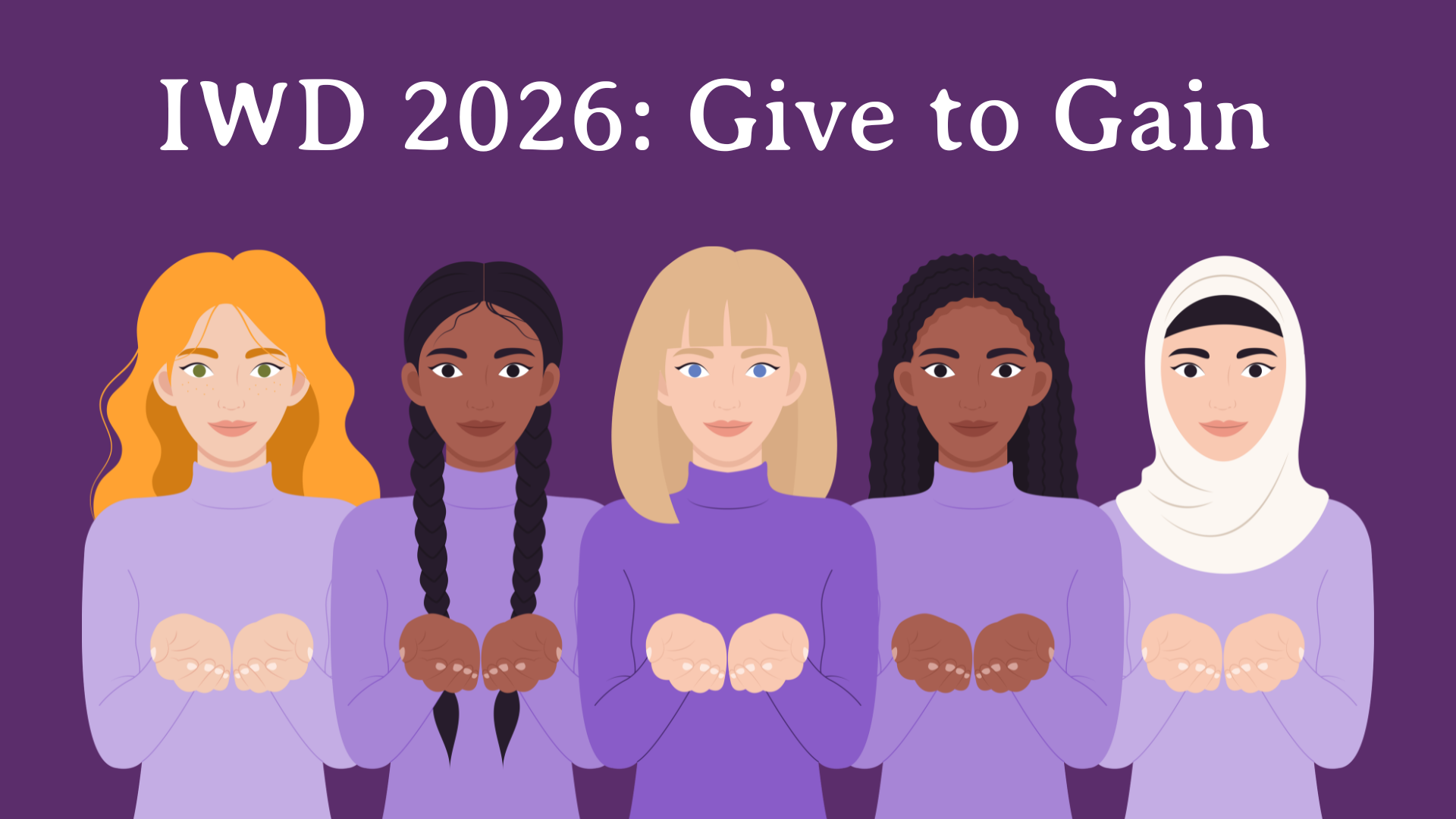
IWD 2026: Give to Gain
This year, the theme of International Women’s Day is “Give to Gain,” which encourages a mindset of generosity and collaboration. This theme asks: What can we give to help advance women and girls? It’s a worldwide call to contribute in some way, whether that be donating to women’s organizations, giving time to mentorship programs, volunteering with a like-minded group, or supporting through daily actions that challenge discrimination or question bias.
Ways to Support Women and Girls in 2026
If you’re here, reading this article, it probably means you have a vested interest in supporting women and girls in 2026. We’ve got some tips on turning that interest into meaningful action.
1. Donate to an organization that supports women
We get it—these are economically trying times. But, if you have the means, donating money to organizations working for women is a great way to show up for IWD 2026.
Here are some of the Starling Social team’s favourite organizations to support:
For Local Impact
- Fort Garry Women’s Resource Centre: A not-for-profit, feminist organization supporting women and gender diverse people to engage in healthy life choices for themselves and their families through innovative and responsive programming and excellence in service.
- Manitoba Association of Women's Shelters (MAWS): A collective of 11 shelters providing 24/7 crisis lines and support for those experiencing violence in Manitoba.
- Ka Ni Kanichihk: Provides culturally rooted healing, education, and mentorship programs for Indigenous women and families.
For International Support
- Plan International’s ‘Because I am a Girl’: Join a growing movement of girls’ rights champions who are committed to helping girls step into their power and shape their communities.
- United Nations Foundation WithHer Fund: Provides flexible funds to local, high-impact, frontline, grassroots women’s rights organizations that have been tackling gender-based violence (GBV)—particularly violence against women and girls (VAWG)—in their communities.
Or, check out the Canadian organizations from the IWD 2026 giving directory.
2. Give Time
Finding worthwhile organizations to mentor for or volunteer with is an excellent way to support IWD 2026. Find a charity, group, or cause that aligns with your values and consider offering your time or skills. There are so many ways to volunteer, and so many organizations that rely on volunteer support to create meaningful change.
Volunteer Manitoba is a great resource to start your volunteer journey.
If you’re curious about mentorship, IWD is hosting a free virtual webinar that explores what #GivetoGain looks like in practice through the lens of mentorship and leadership communication.
3. Support Women-Owned Businesses and Organizations
Supporting women-owned businesses intentionally and consistently is a tangible way to invest in economic equity. Consider purchasing from a local, women-owned business this month, or, find some new businesses to follow, engage with, positively review and share online.
Check out the WeMB directory which highlights women+ owned businesses.
And the black-owned Manitoba business directory.
Or search for similar resources in your city.
4. Educate Yourself & Others
Part of showing up for women is staying informed about the injustices that affect women locally and globally, and recognizing that these issues deserve our attention.
It can also mean investing in your own learning through Diversity, Equity, and Inclusion training or other educational opportunities that deepen your understanding of systemic inequality.
And don’t keep it to yourself! When you learn something new, share it with others through conversations, resources, or thoughtful discussions to create meaningful ripple effects.
We recommend Equality Now and UN Women for some great online resources.
5. Moving Beyond Performative Support
It’s so easy to pay lip service to supporting women, but the real magic lies in action. Sometimes, that means taking an honest look at ourselves, our communities, and the standards we are willing to uphold. At a time when women’s rights are under attack from every angle, personal and collective accountability to action is essential.
Accountability to action could look like:
- Voting for leaders who prioritize women’s rights, and then holding them accountable to the policies and programs that they promised.
- Expecting transparency from businesses that claim to value equality, including equitable pay and representation.
- Not laughing at jokes made at the expense of women.
- Refusing to unfairly criticize women.
- Organizing or attending protests, rallies, or other grassroots efforts.
- Calling Out and Calling In. This means recognizing misogynistic or harmful behaviour in others, naming it, and then demanding better (and explaining what better looks like).
- Understanding that silence in the face of oppression is complacency.
At the end of the day, everyone’s capacity looks a little different, and everyone has something different to give. Not every action needs to be large or public to matter. But meaningful change happens when each of us chooses to participate in building a safer, more equitable world for women and girls.
Best Practices for Using AI in Digital Marketing
AI: What is it good for? Absolutely some things.
In 2026, digital marketers are bombarded with news and speculation about what AI can do, what it will be doing soon, how we should be using it, and how it will take our jobs. And with little to no regulation in place, we see marketing that runs the gamut of AI use in terms of ethics and efficacy.
Here at Starling Social, we believe in giving good advice which will be true and useful for the long term, so we have been hesitant to dive into AI due to the rapidly changing nature of the technology. But we have come to see a few truths about AI in digital marketing that we believe can help guide our work in 2026.
When you work with Starling Social, you’re still getting content created by humans, for humans. Research shows that savvy social media users recognize – and really dislike – AI-generated content. Not to mention that AI won’t know your business, your brand standards, or be able to generate images of your staff, facilities or customers.
However, there are some ways AI can help in our work without compromising quality. Here are some ways we are finding AI useful in 2026, along with best practices for using AI in digital marketing.
AEO/GEO vs SEO
In a study conducted in November 2025, more than a third of internet users started web searches with AI tools (as opposed to traditional search engines). This number is growing, which means it is increasingly important to be optimizing for AI search (also known as AEO, Answer Engine Optimization, or GEO, Generative Engine Optimization) as well as SEO.
Thankfully, GEO is not at odds with SEO, and shares a lot of the same principles – just a little more specific. There are many pieces to this, but for web copy, writing clearly and concisely, and getting to your key points and keywords within 150 words of the beginning of a page or article are a big help.
AI for generating content ideas
Something we see a lot of in our industry is AI being used to generate ideas for social media and blog content.
In a broad sense, AI can be pretty good at this. You can use your favourite chatbot to (almost) instantly generate a list of concepts and ideas which you may not have thought of otherwise, or certainly as quickly. Those concepts might give you what you’re looking for, or help spark a better and more focused idea.
However, it’s worth remembering the limits of AI before you become too reliant on it for idea generation. First, AI will generally be behind on any trends or timely data, as it can only be trained on content which already exists. Second, and similarly, AI generally won’t give you any truly novel ideas, because again, it is drawing only on content that already exists.
AI for research
As we mentioned earlier, people are increasingly turning to AI as an alternative to traditional search engines – and often for good reason. Traditional search seems to be getting worse in quality, and AI often allows for more specific, targeted search and results.
This is especially true for doing research, as most AI tools will pull up and summarize published data with links to where it found the information, allowing you to fact-check its own results. This is crucial, because AI is also prone to occasional hallucinations – but as long as you’re double checking any facts and data you want to use, it can certainly streamline aspects of the research process.
AI for data analysis
For those actually conducting their own research, surveys, or reviewing data, AI does some of its best work in analysis. Feeding your own high-quality data to an AI tool and asking it for statistics and insights allows you to skip the Excel exercises and streamline your analysis.
Many CRM and database tools are also now integrating AI for this exact reason, allowing you to draw insights from your own customer, donor or survey data. This is one of our favourite uses of AI, as it’s more about leveraging real data and computer power to improve your marketing than it is about taking a shortcut.
AI for advertising optimization
Most digital advertising platforms now have AI-powered tools for optimizing your ads, whether through automated A/B testing, honing or broadening your audience, testing different placements, or even automated content variations.
While we wouldn’t suggest these for every brand and every ad, the data suggests these are often useful. Our advice is to try these out for yourself, but pay close attention to what aspects of your ads might be altered by the AI, and consider whether that is appropriate for your ads and brand.
For instance, if your ads rely on some very specific wording – perhaps because you’re in a regulated industry or have a certain type of promotion in your ad – you will want to avoid any AI altering your actual content.
Subscribe for more
Looking for more guidance on how to optimize your digital marketing? Want to keep your finger on the pulse of AI and what role it plays in our industry? Subscribe to the Starling Social newsletter!
Every second Tuesday, we put together the latest digital marketing news and some helpful articles, both from our blog and around the web. And the best part is, it’s free! Subscribe today and start leveling up your digital marketing.
All The Small Things
- by Luke Thiessen
A book of writings by Alyson Shane, supporting the award in her name
We have some exciting news to share, especially for those who knew or worked with Alyson, our founder.
A few of Alyson’s family and friends have put together a book of her writing, taken from her personal blog during the last three years of her life. This book, called All The Small Things, is now available through Amazon – and all proceeds (about $10 per copy) are being donated to the Alyson Shane Memorial Award.
Why now?
We felt now was a good time to release this book into the world for a few reasons.
January is always a big month for conversations around mental health. Between the short, gloomy winter days and the frigid weather keeping many of us cooped up inside, it’s a tough time for a lot of people. We’ve just passed Blue Monday and Bell Let’s Talk Day, and still have some winter left to come.
Mental health was a frequent topic for Alyson; she was a passionate advocate for others getting the help they need, and she spoke openly about her own struggles. The writings selected for this book reflect that, with many entries delving into mental health and related challenges.
The other reason for the timing is that the team behind the Alyson Shane Memorial Award is hoping to reach their fundraising this year if possible, in order to begin awarding money to students.
About the book
All The Small Things is a collection of writings from Alyson’s personal blog between 2022 and her passing in late 2024. As Alyson’s husband John says in the preface, it would be impossible to be exhaustive without producing a Count Of Monte Cristo, so the collection is limited to what he viewed as the most poignant and representative blog posts from the final years of her life.
Reading through the book in order, it paints a picture of Alyson’s inner world, as she saw and wanted to express it. From tender and difficult moments presented with raw honesty, to reflections on the best of times, to a list of frog and toad puns dreamt up with friends late one summer’s evening, it is a very beautiful, very human journey.
It also includes many of the photos (and, of course, memes) which she included in her original posts.
About the award
As mentioned, all proceeds from sales of the book are going to fund the Alyson Shane Memorial Award in Rhetoric, administered by the University of Winnipeg Foundation.
Once fully funded, the award will help underrepresented students studying rhetoric, communications and writing at the U of W. The fundraising goal in order to begin awarding is $35,000, and as of now, is nearly half funded.
Anyone interested in supporting the award directly can find out more information or make a contribution through the University of Winnipeg Foundation here.
Where to buy
All The Small Things is published and sold through Amazon, and you can buy it here.
The books are printed in (and shipped from) Canada, and eligible for fast free delivery on Prime.
For any questions about the book or the award, please get in touch - we’re always happy to chat!
Our 2026 Digital Marketing Checklist
What we’re planning for, bracing for, and watching for this year in the world of digital marketing
By Luke Thiessen, Director
I used to call it “Mythical January.”
In a previous job where I led a nonprofit communications team, we would talk all year – especially as we neared and weathered the busy holiday season – about Mythical January. It was the time when we all expected to be able to sit back, catch up on all of the projects that fell by the wayside throughout the year, and plan for the year ahead.
But every year, without fail, we would reach Mythical January, and two things would happen. First, we would realize the list of things we left for January was longer than we could possibly tackle. And second, some opportunity or emergency would come up that would shake us from our leisurely catch-up session and set us right back on the hamster wheel of work that wouldn’t stop again until after Christmas.
So this year, I thought I’d kick off the Starling blog with some planning advice and insights to help you make the most of your Mythical January – whatever that looks like for you.
We’re going to look at some of the challenges, opportunities, and emerging technologies that we expect will warrant our attention this year. I hope this helps you plan your 2026 digital marketing and strategize for the year to come!
A.I. Everything
You know we had to start here. Sometimes we love it, sometimes we hate it, but it’s not going away, so might as well embrace it.
We still believe human-created content is king, and will continue to be this year, but we as marketers know that AI is making its way into more facets of our work – so it’s important to understand what’s happening.
One area where we’re watching AI closely is in ad delivery. Many of our main digital ad channels are integrating AI into how they do targeting and placements, including Meta and Google. So for 2026, we are watching the data closely to see if and how these tools actually impact results, what the best use cases are, and if there are any issues we need to be watching for.
Another major area of AI integration we are watching is in search. This impacts a few things, from how we approach SEO on our websites and blogs to PPC (Pay-Per-Click) advertising in search. So far, this has had a smaller and slower impact than many marketers feared, but AI is still changing the way we approach search engine marketing. So for 2026, we are continuing to invest in the tools and strategies that continue to deliver results, but we are also bracing for a future where much of this could change.
We are also watching the AI regulatory landscape this year, as 2025 already brought some significant international developments which could hint at what’s to come. Regulation in the EU (as well as China and some parts of the U.S.) is forcing disclosures for AI-generated content and AI-assisted technologies. There are also active lawsuits in Canada which are likely to impact things here, as our government has indicated it’s watching for court decisions before enacting any AI regulation.
Alternative Search
This overlaps somewhat with what we’re watching in AI, but two major shifts are happening in search right now that cannot be ignored: chatbots as search, and social media as search.
AI chatbots are quickly taking market share from traditional search engines, as more people type their queries directly into ChatGPT or other AI tools. The line here blurs a little, as the chatbots appear to be getting at least some of their results directly from Google (not to mention Gemini, one of the most popular chatbots, is a Google product). However, it is a significant trend that is changing how many users engage with search.
Social media is doing something similar, especially among younger users who are typing queries directly into the (mostly AI-powered) search bars within social media apps. This makes SEO more complicated in a lot of ways, but at minimum reinforces the importance of having good strategic copy across all of your social media content.
Short-Form Video
Video has been the king of content for a while now, but its importance just keeps growing. TikTok shows no signs of slowing down, and virtually every other platform is scrambling to keep users on board by prioritizing similar video feeds.
For 2026, we are watching the pace of this shift to video-first, looking at more efficient and cost-effective ways of embracing video content, and evaluating how this should fit into overall strategy for our clients.
Authenticity
In the age of AI slop and automated marketing, we (as well as many other experts) believe that authenticity will only become more important in 2026.
Authenticity has always been one of our core values at Starling Social, but we are seeing increasing evidence that it makes for more effective digital marketing. Real people want to see and hear real people in their social feeds, and that applies to advertising too.
The challenge here is that video is often the most expensive and/or labour-intensive content to make, whether for organic social or ads. However, making something that feels authentic can also mean making something less polished and more natural – so there is also opportunity here for marketers with smaller budgets and modest tools.
Niche Platform Advertising
Perhaps less of a trend and more of a personal project, something I’m trying to watch and do more of in 2026 is marketing on niche platforms.
You might not think of Reddit or LinkedIn as niche (both boast huge user numbers), but their advertising programs are barely a fraction of the size of Meta and Google. However, both have invested significantly in the quality of their ad business recently, and can deliver great results for a good price if done well. Targeting and placements naturally work differently here than on Meta or Google, and they are both home to strong niche communities of users, creating advertising opportunities you just can’t get elsewhere.
Getting Professional Help
Overall, it seems the world of digital marketing just keeps getting more challenging and complex – and in 2026 the pace of change has become almost dizzying. But that’s why we’re here.
If you could use help navigating any of this – from adapting your advertising strategy for AI, to creating more video content, to trying something new with your digital marketing – get in touch to book a discovery call today.